• About
    • Contact

Site Title

  • Mom

    May 13th, 2023

    IN MY earliest memory of Mom she is talking with the milkman. Back in the day – early to mid- sixties — the Ewald Bros. milk truck came down Wilford Way once or more times a week. Stopping at our house, the milkman would dutifully carry our order up a lot of steps on the side hill up to the second story kitchen. Normally he’d put our goods in the corrugated tin box by the door and be on his way, but this day Mom caught him and found a willing conversational partner. The milkman stood in the threshold as Mom and he chatted, and talked, and discussed. I don’t recall any of their conversation, but it went on so long that I, developing my penchant for anxiety, worried that Mom would make the milkman late for his appointed rounds.

    Mom loved talking. I don’t know how she wound up with such a taciturn kid as me, but there you go. Mom would look for settings conducive to conversation. The Wednesday night bridge club went on for years, where the ladies of the card table could freely chat. She was in a bowling league, also for years (team name: Wil-Ways), I’m sure more for the social comradery than the chance to beat the ladies from Dunberry Lane. And often, after Dad got home from work, the two of them would sit in the living room, in their matching chairs on either side of the antique serving table, discussing whatever there was to discuss, the room filling with cigarette smoke.

    During the time I knew her, Mom was a suburban mom, with all that entails, but she confounded the stereotype. I think she found Edina a little stifling, and kind of funny. I don’t remember the source, but she cut out and kept a satirical poem about living in Edina (“with your living room window looking into mine…”). She had a good perspective about her place, and threw herself wholly into what suburban life afforded her. She was well-liked by all the other housewives on Wilford Way.

    She never had a job, but she was always working. Laundry, cleaning, ironing. Making the beds, nice and tight. Putting Gold Bond and S&H stamps in the booklets. Bowling team captain, bowling league secretary. Making crafts (some still decorate our tree at Christmas). Once all us kids were in school, she did more outside of home: Working at the Blue Goose Auxiliary (I never really knew what that was), volunteering at the Abbott Hospital gift shop. Helping at the Reidhead’s Hallmark store in DinkyTown. She was exuberant about it all.

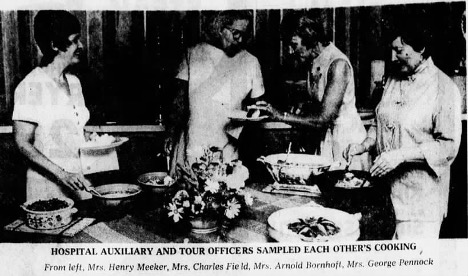
    There’s a photo published in the Taste section of the Minneapolis Star in 1970, captioned “Hospital Auxiliary and Tour Officers Sampled Each Other’s Cooking.” It illustrates an article on the 10th Annual Abbott Kitchen Tour. The photo shows Mom (”Mrs. Arnold Bornhoft”) and three other women at a table filled with serving dishes and platters of food. Mom makes the photo worth publishing. She’s intently and joyfully serving one of the women a serving of some dish. The other women in the photo are smiling, but a little stiff.
    Mom hated getting old. She actively hated it. I remember handmade “Life Begins at Forty” signs at the house, for a neighborhood party she hosted to celebrate that dreaded birthday. More than once she would lament, “Youth is wasted on the young,” as she looked at her boys lounging in front of the TV.

    When I was in first grade Dad bought a cabin on a lake outside Siren, Wisconsin, and it became Mom’s favorite place to be.  

    She did what she could to make every day at “the lake place” a sunny day. She christened our tree fort “Fort Sunny,” the name spelled out in tree twigs on the side. She would look up at a cloudy sky and say, “I think it’s getting brighter.”

    I picture her on the boat, fishing, anticipating the thrill of the catch. And sitting on the deck, containers of geraniums (her favorite) all around, at the end of the day.

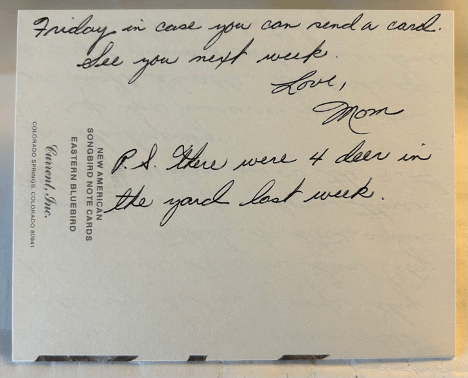
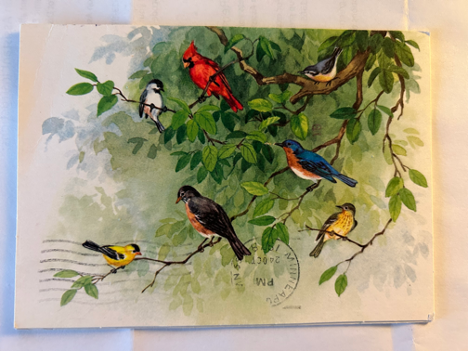
    Mom loved songbirds. Whether this started with life at the cabin or before I don’t know, but it was one of the biggest interests of her life. She was ecstatic when we spotted a scarlet tanager at the lake place. She loved when the phoebes came back to the nest above the door every year. She once had a chance to meet Roger Tory Peterson, a noted ornithologist and nature artist; for her it was meeting a rock star. Her collection of ceramic bird sculptures kept growing until a cabinet was purchased just for their display. Notecards she sent to me at college always, always featured songbirds.
    Like many things that seem to go on forever, we only had the cabin a short number of years. By the time I was in seventh grade Dad had sold it. We moved from Edina to a wooded acre lot in (Prestigious West) Bloomington, mostly to satisfy Mom’s love for the outdoors.

    Mom loved to read. I’m sure it was a way for her to escape her suburban setting. I remember her reading books by Lowell Thomas, a foreign correspondent and travel writer. And like many women I think she was inspired by the essays of Anne Morrow Lindbergh, widow of Charles.

    _________________

    On a day in March of my junior year at Gustavus Adolphus College, the chaplin left a message for me to come to his office. Obviously something was up. I figured it might be about Dad’s stepdad, Grandpa Bill, who had various health issues. Mark and Jan were living in Minneapolis, Steve I think was in Madison, Wisconsin. Mom and Dad were vacationing in Mazatlán, using a condo in the Reidhead family.

    I was nervous as I sat down in Chaplin Elvee’s office. “Your mother died last night in Mexico,” he said, directly but calmly. He remained quiet for a minute while I took it in.

    Mom was 51 years old. Dad later told us she had collapsed while they were walking on the beach. After Dad asked someone to get help, he knelt by Mom. Mom, conscious but unable to talk, looking at Dad, took off her wedding ring, and put it in Dad’s hand.

    Kim wears that ring now. The ceramic sun that hangs on our front porch was purchased by Mom in Mazatlán.

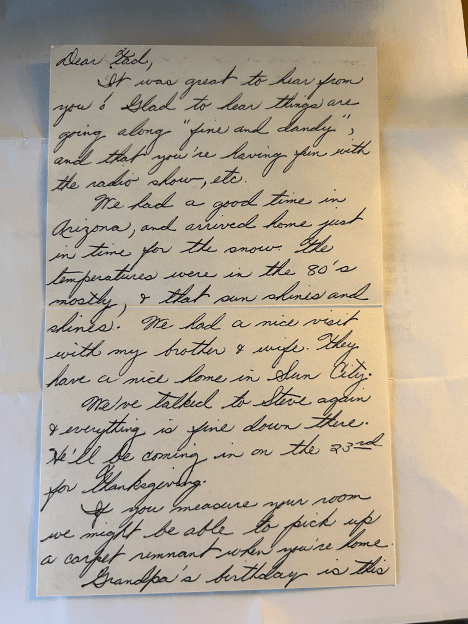
    Grandpa Bill had picked me up from Gustavus. When I got home and went up to my room, my bankbook was on my desk, where Mom always put it after she’d made a deposit for me. She had washed my sheets since I’d last been home, and had made my bed, neatly and tightly, like she always did.

  • Chapter One

    May 13th, 2023

    The studio was filled with the rich odour of roses, and when the light summer wind stirred amidst the trees of the garden, there came through the open door the heavy scent of the lilac, or the more delicate perfume of the pink-flowering thorn.

    From the corner of the divan of Persian saddle-bags on which he was lying, smoking, as was his custom, innumerable cigarettes, Lord Henry Wotton could just catch the gleam of the honey-sweet and honey-coloured blossoms of a laburnum, whose tremulous branches seemed hardly able to bear the burden of a beauty so flamelike as theirs; and now and then the fantastic shadows of birds in flight flitted across the long tussore-silk curtains that were stretched in front of the huge window, producing a kind of momentary Japanese effect, and making him think of those pallid, jade-faced painters of Tokyo who, through the medium of an art that is necessarily immobile, seek to convey the sense of swiftness and motion. The sullen murmur of the bees shouldering their way through the long unmown grass, or circling with monotonous insistence round the dusty gilt horns of the straggling woodbine, seemed to make the stillness more oppressive. The dim roar of London was like the bourdon note of a distant organ.

    In the centre of the room, clamped to an upright easel, stood the full-length portrait of a young man of extraordinary personal beauty, and in front of it, some little distance away, was sitting the artist himself, Basil Hallward, whose sudden disappearance some years ago caused, at the time, such public excitement and gave rise to so many strange conjectures.

    As the painter looked at the gracious and comely form he had so skilfully mirrored in his art, a smile of pleasure passed across his face, and seemed about to linger there. But he suddenly started up, and closing his eyes, placed his fingers upon the lids, as though he sought to imprison within his brain some curious dream from which he feared he might awake.

    “It is your best work, Basil, the best thing you have ever done,” said Lord Henry languidly. “You must certainly send it next year to the Grosvenor. The Academy is too large and too vulgar. Whenever I have gone there, there have been either so many people that I have not been able to see the pictures, which was dreadful, or so many pictures that I have not been able to see the people, which was worse. The Grosvenor is really the only place.”

    “I don’t think I shall send it anywhere,” he answered, tossing his head back in that odd way that used to make his friends laugh at him at Oxford. “No, I won’t send it anywhere.”

    Lord Henry elevated his eyebrows and looked at him in amazement through the thin blue wreaths of smoke that curled up in such fanciful whorls from his heavy, opium-tainted cigarette. “Not send it anywhere? My dear fellow, why? Have you any reason? What odd chaps you painters are! You do anything in the world to gain a reputation. As soon as you have one, you seem to want to throw it away. It is silly of you, for there is only one thing in the world worse than being talked about, and that is not being talked about. A portrait like this would set you far above all the young men in England, and make the old men quite jealous, if old men are ever capable of any emotion.”

    “I know you will laugh at me,” he replied, “but I really can’t exhibit it. I have put too much of myself into it.”

    Lord Henry stretched himself out on the divan and laughed.

    “Yes, I knew you would; but it is quite true, all the same.”

    “Too much of yourself in it! Upon my word, Basil, I didn’t know you were so vain; and I really can’t see any resemblance between you, with your rugged strong face and your coal-black hair, and this young Adonis, who looks as if he was made out of ivory and rose-leaves. Why, my dear Basil, he is a Narcissus, and you—well, of course you have an intellectual expression and all that. But beauty, real beauty, ends where an intellectual expression begins. Intellect is in itself a mode of exaggeration, and destroys the harmony of any face. The moment one sits down to think, one becomes all nose, or all forehead, or something horrid. Look at the successful men in any of the learned professions. How perfectly hideous they are! Except, of course, in the Church. But then in the Church they don’t think. A bishop keeps on saying at the age of eighty what he was told to say when he was a boy of eighteen, and as a natural consequence he always looks absolutely delightful. Your mysterious young friend, whose name you have never told me, but whose picture really fascinates me, never thinks. I feel quite sure of that. He is some brainless beautiful creature who should be always here in winter when we have no flowers to look at, and always here in summer when we want something to chill our intelligence. Don’t flatter yourself, Basil: you are not in the least like him.”

    “You don’t understand me, Harry,” answered the artist. “Of course I am not like him. I know that perfectly well. Indeed, I should be sorry to look like him. You shrug your shoulders? I am telling you the truth. There is a fatality about all physical and intellectual distinction, the sort of fatality that seems to dog through history the faltering steps of kings. It is better not to be different from one’s fellows. The ugly and the stupid have the best of it in this world. They can sit at their ease and gape at the play. If they know nothing of victory, they are at least spared the knowledge of defeat. They live as we all should live—undisturbed, indifferent, and without disquiet. They neither bring ruin upon others, nor ever receive it from alien hands. Your rank and wealth, Harry; my brains, such as they are—my art, whatever it may be worth; Dorian Gray’s good looks—we shall all suffer for what the gods have given us, suffer terribly.”

    “Dorian Gray? Is that his name?” asked Lord Henry, walking across the studio towards Basil Hallward.

    “Yes, that is his name. I didn’t intend to tell it to you.”

  • Chapter Two

    May 13th, 2023

    “Oh, I can’t explain. When I like people immensely, I never tell their names to any one. It is like surrendering a part of them. I have grown to love secrecy. It seems to be the one thing that can make modern life mysterious or marvellous to us. The commonest thing is delightful if one only hides it. When I leave town now I never tell my people where I am going. If I did, I would lose all my pleasure. It is a silly habit, I dare say, but somehow it seems to bring a great deal of romance into one’s life. I suppose you think me awfully foolish about it?”

    “Not at all,” answered Lord Henry, “not at all, my dear Basil. You seem to forget that I am married, and the one charm of marriage is that it makes a life of deception absolutely necessary for both parties. I never know where my wife is, and my wife never knows what I am doing. When we meet—we do meet occasionally, when we dine out together, or go down to the Duke’s—we tell each other the most absurd stories with the most serious faces. My wife is very good at it—much better, in fact, than I am. She never gets confused over her dates, and I always do. But when she does find me out, she makes no row at all. I sometimes wish she would; but she merely laughs at me.”

    “I hate the way you talk about your married life, Harry,” said Basil Hallward, strolling towards the door that led into the garden. “I believe that you are really a very good husband, but that you are thoroughly ashamed of your own virtues. You are an extraordinary fellow. You never say a moral thing, and you never do a wrong thing. Your cynicism is simply a pose.”

    “Being natural is simply a pose, and the most irritating pose I know,” cried Lord Henry, laughing; and the two young men went out into the garden together and ensconced themselves on a long bamboo seat that stood in the shade of a tall laurel bush. The sunlight slipped over the polished leaves. In the grass, white daisies were tremulous.

    After a pause, Lord Henry pulled out his watch. “I am afraid I must be going, Basil,” he murmured, “and before I go, I insist on your answering a question I put to you some time ago.”

    “What is that?” said the painter, keeping his eyes fixed on the ground.

    “You know quite well.”

    “I do not, Harry.”

Blog at WordPress.com.


Loading Comments...
 

    • Subscribe Subscribed
      • Site Title
      • Already have a WordPress.com account? Log in now.
      • Site Title
      • Subscribe Subscribed
      • Sign up
      • Log in
      • Report this content
      • View site in Reader
      • Manage subscriptions
      • Collapse this bar